
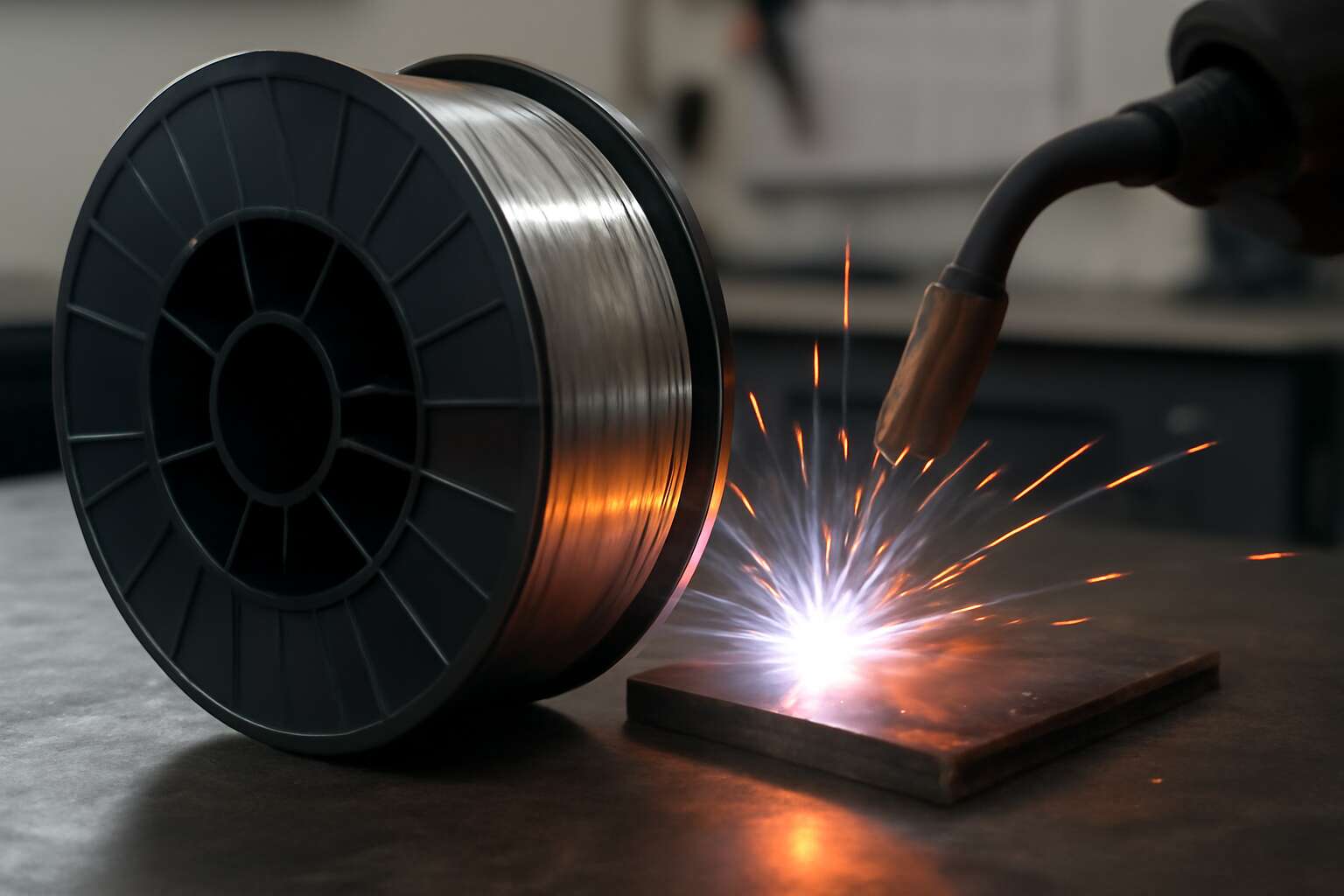
Overview of stainless steel flux-cored welding wire
What is stainless steel flux-cored welding wire
Across South Africa, fabricators report up to 20% faster throughput when using stainless flux core mig wire. That edge isn’t a marketing line—it’s a reflection of how the flux core stabilizes the arc, protects the molten pool, and minimizes rework on stainless joints.
Stainless steel flux-cored welding wire is a tubular consumable filled with flux. As it melts, the flux generates shielding and adds alloying elements that boost corrosion resistance and weld integrity for stainless grades such as 304 and 316, making pipework and tanks more reliable.
Key advantages include:
- Enhanced corrosion resistance from stainless alloying elements
- Improved arc stability and feedability for tight joints
- Reduced shielding gas dependency in certain setups
In choosing stainless flux core mig wire, South African shops weigh base material, position, and throughput goals—and I’ve seen how consistency from Cape Town to the Highveld helps projects move smoothly.
Core benefits and limitations
From Cape Town’s pale dawn to the Highveld’s midnight glow, fabricators whisper a statistic that sounds almost supernatural: throughput can leap by 20% when stainless flux core mig wire powers the weld. I’ve watched the flux inside the tubular heart steady the arc, shield the molten pool, and curb rework on stubborn joints, turning metal into a faithful ally.
Stainless flux core mig wire threads a cautious spell: its flux chemistry both shields and injects alloying elements that bolster corrosion resistance in grades like 304 and 316. You’ll welcome smoother feed and steadier arc in tight joints, yet beware slag remnant and a learning curve in torch control. Moisture-susceptible flux and higher cost temper expectations on projects that demand polish as well as strength.
- Reduced wind sensitivity and steadier shielding in field work
- Slag removal required but it protects the weld during solidification
- Moisture control matters; dry storage is essential to prevent porosity
Common stainless grades used with flux-cored wire
Stainless flux core mig wire is a sneaky protagonist in metalwork, turning stubborn joints into cooperative alloys with a wink. In South Africa’s bustling workshops, throughput can leap by up to 20% when stainless flux core mig wire takes the lead. The arc hums, the feed stays calm, and even stubborn gaps concede with a quiet cheer—stainless flux core mig wire, yes, it’s that good.
The flux core within this wire releases shielding compounds as it welds, helping tame gusty winds and maintain a stable arc across varying thicknesses. It suits tight joints and awkward angles, and careful moisture control keeps porosity at bay—no drama, just dependable performance.
Common stainless grades used with flux-cored wire include the following stalwarts:
- 304 stainless – general-purpose with solid corrosion resistance
- 316 stainless – excels in chloride-rich environments
- 321/347 stainless – stabilized for heat and welded assemblies
- 316L/308L stainless – versatile fillers for diverse joints
Core chemistry and shielding gas considerations
Stainless flux core wire wears a sly grin in the workshop, outwitting windy SA mornings where joints resist cooperation. The flux core liberates shielding compounds as it welds, taming gusts and keeping the arc steady. For stainless flux core mig wire, this chemistry yields a robust bead and controlled porosity.
Shielding gas considerations split into self-shielded versus gas-assisted formulations. Self-shielded options rely on the flux itself; gas-assisted variants pair a deliberate blend with the wire to refine stability, especially in tight joints.
- Self-shielded flux-core options excel outdoors with minimal equipment.
- Gas-shielded blends (argon-rich or CO2 blends) improve bead quality and corrosion resistance.
In this balance of core chemistry and shielding, the weld stays precise and durable, even amid moist South African workshops.
Key performance indicators to monitor
stainless flux core mig wire delivers a steady arc even when the workshop doors yaw and wind sneaks in from the coast, almost spectral in its certainty. In South Africa’s diverse environments, you measure a weld not just by strength but by predictability, bead shape, and deposit quality. The key performance indicators you watch in real time keep you from chasing shadows and soggy joints.
Bead geometry, fusion consistency, and metallurgical integrity ride at the top of the list. The following indicators help calibrate performance:
- Bead width and uniformity
- Porosity control and slag management
- Deposited alloy composition and corrosion resistance
Reliability comes from the same stainless flux core mig wire approach prized in harsher environments across South Africa. In busy workshops, weather, humidity, and power quality test every weld, so these indicators stay monitored across joint types and base materials to keep results repeatable.
Selecting alloy grades and compatibility for stainless flux-cored wires
Alloy selection guides for stainless flux-cored wire
Choosing alloy grades for stainless flux core mig wire can be the difference between a solid joint and costly rework. A SA fabricator once said, “the alloy you pick writes the fate of the weld.” Match the grade to base metal and service conditions—especially coastal corrosion in South Africa. Stainless flux core mig wire is a family designed to balance weldability, strength, and corrosion resistance in real-world environments.
- Base metal compatibility: 304 vs 316 vs duplex vs ferritic
- Environment: chloride exposure, humidity, and alkaline soils common in some SA areas
- Cartridge and filler chemistry: ferrite numbers, austenitic balance, and the target service
- Thickness and heat input: dilution effects and crack susceptibility
Manufacturers publish compatibility data and service recommendations. In coastal SA projects, the match between the filler family and the base grade shapes long-term performance and helps withstand chloride exposure and temperature swings without surprising failures.
Wire diameter and coating options
Welds live or die by alloy choice, especially near the coast. A SA fabricator once quipped, “the alloy you pick writes the fate of the weld.” Selecting alloy grades for stainless flux core mig wire isn’t guesswork—it’s balancing base metal, service conditions, and long-term corrosion defense.
Base metal options—304, 316, duplex, ferritic—plus coastal humidity and chloride exposure drive the filler chemistry: ferrite numbers and austenitic balance affect crack resistance and dilution. Manufacturers publish compatibility data for SA projects, and matching the filler family to the base grade shapes performance in the field.
- Diameter options: 0.8, 0.9, 1.0, 1.2 mm
- Flux/coating chemistry: balances ferrite vs austenite and slag formers
- Environment fit: coastal chloride exposure and humidity considerations
Choosing the right stainless flux core mig wire matters, especially for SA coastal projects where corrosion dynamics swing with the tides.
Shielding gas options and their impact
Coastal SA weld environments demand more than heat and metal. The alloy you choose for stainless flux core mig wire shapes the weld’s fate in salty air and humid days. Selecting alloy grades and ensuring compatibility isn’t guesswork—it’s balancing base metal, service conditions, and long-term corrosion defense. Manufacturers publish compatibility data for SA projects, helping you pair the filler family with base grades like 304, 316, or duplex as tides shape the work.
Shielding gas options and their impact form another critical dimension. For stainless flux core mig wire, these choices influence arc stability, bead appearance, and resistance to cracking in coastal climates.
- 100% argon for smooth deposition and clean fusion
- argon/CO2 blends (e.g., 98/2 or 95/5) for stable arc and better wetting
- tri-mix options (argon/CO2/O2) for demanding joints in high humidity
These gas decisions interact with filler chemistry to shape the weld pool’s ferrite vs austenite balance and the overall corrosion performance across SA coastal projects.
The gas– alloy pairing reads like a maritime saga written in steel.
Base metal compatibility and thickness ranges
Coastal fabricators know a weld is more than metal—it’s certainty in corrosion-prone air. “The weld writes the story the metal can’t tell,” says a seasoned foreman, and that truth guides every stainless flux core mig wire choice for South Africa’s salt-laden zones.
Base metal compatibility and thickness ranges set the course. Align the filler with base grades such as 304, 316, or duplex, to meet service conditions and heat input. On thin sheets, 0.8–2 mm; medium sections, 2–6 mm; heavyweight work, 6–12 mm.
- Base metals: 304, 316, duplex
- Thickness cadences: 0.8–2; 2–6; 6–12 mm
- Environment cues: humidity and chlorides influence filler pairing
Manufacturers publish compatibility data to reveal which filler families harmonize with your base metal under SA coastal climates.
Welding positions and feedability considerations
The weld writes the story the metal can’t tell, and in SA’s salt-spray zones that story is written in corrosion risk. Choosing alloy grades for stainless flux core mig wire hinges on service conditions: 304 for general corrosion resistance, 316 for chlorides, and duplex for aggressive jointing. Manufacturer compatibility charts reveal which filler families pair best with base grades under coastal climates, guiding heat input and long-term weld integrity. In humid air, the right wire becomes a shield, not just a consumable.
Welding positions and feedability drive arc stability in practice. Common positions to consider are:
- Flat
- Horizontal
- Vertical
- Overhead
Feedability matters as much as chemistry: wire diameter, drive tension, and torch reach shape deposition across joints. A stable stainless flux core mig wire yields steady deposition and clean slag removal, essential for long runs in coastal SA projects.
Industrial applications and typical use cases for stainless flux-cored welding wire
Applications in fabrication and equipment manufacturing
In South Africa’s bustling workshops, every weld is a vow to durability and possibility. Consider how the stainless flux core mig wire—sturdy, versatile, economical—transforms fabrication in harsh environments. It helps factories keep pace with demand and workers take pride in their craft.
Here are typical industrial applications in fabrication and equipment manufacturing:
- Structural frames and supports for mining and construction equipment
- Pressure vessels, reactors and piping in food, beverage and water-treatment sectors
- Marine, offshore and agricultural machinery exposed to salt spray and moisture
Beyond the obvious strength and beauty of the welds, these alloys help reduce rework and downtime, enabling quicker production lines and longer service life in SA markets. The right approach lets teams push the envelope with confidence and care, turning harsh realities into lasting performance and pride!
Food processing and pharmaceutical equipment
In South Africa’s food processing and pharmaceutical plants, downtime costs can climb by up to 20% of annual output, a toll felt with every stubborn delay. The use of stainless flux core mig wire delivers clean, corrosion-resistant joints that resist caustic cleaners, CIP cycles, and frequent washdowns. Welders achieve reliable seals and longer service life in critical process equipment.
- Sanitary piping and valves for CIP lines
- Stainless tanks, mixers and vessels
- Pharmaceutical fill lines and process tubing
- Support structures on equipment exposed to washdowns
Beyond these advantages, the joints maintain hygienic standards and uptime in high-demand food and pharma lines, turning demanding environments into enduring performance.
Architectural metalwork and structural components
Architectural metalwork is where design meets environment. A single, well-executed weld can define a facade’s longevity as surely as its silhouette defines its identity. For outdoor and interior structures alike, stainless flux core mig wire delivers clean, corrosion-resistant joints that stand up to rain, humidity, and the rigors of climate cycles. In structural components and decorative panels, it ensures both strength and beauty stay aligned over decades.
Common use cases in architectural metalwork include:
- Railing systems and balustrades
- Facade anchors and mounting brackets
- Structural connections in sheltered or exposed locations
- Decorative metal skins and panels
Automotive and heavy equipment welding
South Africa’s workshops hum with heavy machinery. In climates where rain, humidity, and dust meet heat, stainless flux core mig wire delivers clean, corrosion-resistant joints that keep fleets moving.
Automotive and heavy equipment welding requires joints that endure vibration and exposure. This flux-core wire forms solid welds on chassis, exhaust, and structural brackets, resisting wear in mines and on dusty roads.
- Chassis welds on trucks and mining equipment
- Exhaust joints and hot sections
- Structural brackets exposed to salt and mud
The result is resilience that travels from workshop to worksite, turning rugged terrain into lasting performance.
Welding parameters and technique tips for stainless flux-cored welding wire
Recommended voltage and amperage ranges
Stability in your welds is earned, not assumed. With stainless flux core mig wire, tuning heat and arc stability yields cleaner beads and stronger joints. For 0.030–0.045 in wire (0.8–1.2 mm), typical voltage runs in the high teens to low twenties, while amperage sits around 180–320 A, depending on thickness and joint size. These ranges help balance penetration with bead geometry and corrosion resistance on stainless grades, especially when paired with a careful feed and clean base metal.
Here are practical technique notes for optimum results:
- Keep a short arc and a stable travel speed to maintain consistent fusion.
- Maintain a perpendicular torch angle and a smooth weaving pattern to distribute heat evenly.
- Avoid excessive current at start and end; monitor slag and bead profile to minimize porosity.
In South Africa’s diverse fabrication shops, these parameter considerations help sustain corrosion resistance and part integrity without unnecessary rework.
Wire feed speeds and travel technique
Heat balance is the unsung guard of stainless welds. In South Africa’s fabrication yards, up to 70% of stainless weld defects trace back to heat imbalance. That’s where stainless flux core mig wire makes the real difference—it’s about tuning voltage, wire feed, and travel pace to control penetration and bead geometry.
Wire feed speeds and travel technique shape how the molten pool behaves. Aim for steady heat input and a controlled arc that yields consistent fusion without overheating the bead.
- Keep arc length steady to minimize porosity
- Match feed rate to joint size for uniform fusion
- Watch slag and bead profile to spot overheating early
These considerations help preserve corrosion resistance and weld integrity across projects—from food-grade equipment to architectural metalwork—without rework.
Pre-weld preparation and fit-up best practices
Heat balance is the unsung guard of stainless welds, and in South Africa’s fabrication yards, the arc rarely forgives sloppy prep. When joint fit-up is precise and clean, stainless flux core mig wire delivers controlled penetration and predictable bead geometry, turning heat chaos into durable fusion!
Pre-weld preparation and fit-up best practices lay the groundwork. Cleanliness, accurate gapping, and secure fixturing keep the molten pool honest. A tidy root and consistent gaps reduce porosity and preserve corrosion resistance.
With this approach, welding parameters and technique tips count: balance heat input by adjusting voltage, wire feed and travel pace to control penetration and bead profile, and keep arc length steady to minimize porosity.
Post-weld cleaning and passivation suggestions
With stainless flux core mig wire, heat balance becomes a craft rather than a gamble. Balance heat input by tuning voltage, wire feed, and travel pace to control penetration and bead geometry, while keeping arc length steady and the shield intact. In South Africa’s workshops, this discipline turns stubborn heat into durable fusion, yielding smooth contours and deep corrosion resistance when the weld profile breathes with the base metal.
Post-weld cleaning and passivation suggestions: Clean slag and spatter from the bead, rinse with fresh water, and dry promptly to prevent flash rust. Then apply a passivation treatment—citric acid or a reputable stainless passivant—per product instructions to restore and protect the chromium-rich passive film.
- Remove slag and contaminants from the weld zone
- Rinse with clean water and dry thoroughly
- Apply passivation product and follow dwell time
- Audit the surface for uniform brightness and corrosion resistance
Troubleshooting common issues like porosity and spatter
Stainless flux core mig wire demands a conversation with heat and balance; in a South Africa workshop, practitioners know that the arc becomes a craft rather than a gamble when the metal breathes evenly. The technique favors steady travel, crisp wire feed, and a steady arc length to maintain penetration and bead geometry without pushing excess heat into the base metal.
When porosity or spatter shows up, the issue is rarely a single fault but a chorus: moisture, surface contamination, or erratic shielding can upset the choreography. Troubleshooting here means thinking about cleanliness, consistent heat input, and the sturdiness of the shield—not chasing quick fixes. With stainless flux core mig wire, success comes from observing how the weld pool breathes and aligning technique with the base metal’s behavior.
Key considerations for this wire share a calm workflow and proper joint fit, plus a willingness to study the weld as it moves along the seam.
- Surface cleanliness and moisture control
- Steady shielding and arc stability
- Observing weld pool behavior for uniformity
Quality control, testing, and longevity of stainless flux-cored welding wire
Quality control methods and inspection standards
Factories across South Africa’s towns know a weld’s strength starts with the plan behind it. Quality control for stainless flux core mig wire begins before the arc—careful procurement, batch traceability, and storage that keeps the coating pristine. Consistency on every reel matters.
Testing blends science with experience: visual checks, coating weight, and dimensional tolerances, plus macro/micro examinations and bend tests on coupons. For corrosion resistance, short salt-spray or electrochemical checks can validate longevity. When sourcing the same stainless flux core mig wire, you want to rely on consistent chemistry.
- Visual and dimensional checks
- Coating weight and chemistry checks
- Bend tests and corrosion simulations
Longevity grows from stable chemistry, careful handling, and clear traceability—knowing the lot that produced a weld. When these standards are met, stainless products endure the harsh South African environment.
Relevant certifications and standards to seek
Quality is never an accident; it is the result of intelligent effort. In South Africa, that effort starts with stainless flux core mig wire and the traceable journey behind each reel. Careful procurement and proper storage preserve the coating and chemistry for demanding welds.
Testing blends science with hands-on know-how: durability under salt spray, coating integrity, and dimensional checks that mirror real-world welds. With consistent chemistry across batches, you can trust the wire to perform as promised across deadlines and job sites.
- ISO 9001 quality management systems
- ISO 45001 occupational health and safety
- ISO 14001 environmental management
- SA/SABS compliance where applicable
Longevity is born from stable chemistry, careful handling, and full batch traceability—knowing exactly which lot produced a weld. When these standards anchor stainless flux core mig wire, joints withstand South Africa’s harsh environments and corrosion risks.
Storage, shelf life, and handling guidelines
Quality control starts long before the welder strikes. Traceable batches, coating integrity checks, and consistent chemistry are the backbone of dependable stainless flux core mig wire. Careful procurement and storage underpin the process, delivering reels that perform across jobs and climates.
Testing blends science with hands-on know-how: salt spray durability, coating integrity, and dimensional checks that mirror real welds. With consistent chemistry across batches, you can trust the wire to perform on deadline-driven South African job sites.
Longevity is born from stable chemistry, careful handling, and batch traceability—knowing exactly which lot produced a weld. Storage, shelf life, and handling guidelines keep coating and chemistry intact, resisting the humid South African climate.
- Keep reels in their original packaging until first use.
- Store in a dry, ventilated area away from moisture and corrosive vapours.
- Rotate stock using FIFO to ensure consistent quality on site.
Performance in corrosion testing and real-world durability
In South Africa’s harsh job sites, more than 60% of weld failures trace back to wire quality, not the torch. Quality control starts long before the arc, ensuring each batch stays traceable, the coating remains intact, and the chemistry is stable. stainless flux core mig wire performs when the stakes are high and deadlines tight.
- Salt spray durability to gauge corrosion resistance
- Coating integrity checks for flaking or pinholes
- Dimensional checks to mirror real welds
Longevity comes from stable chemistry, careful handling, and robust batch traceability—knowing exactly which lot produced a weld. When coatings and chemistry stay sealed against humidity and dust, the wire delivers durable joints across coastal refinery rigs and inland fabrication yards alike.


0 Comments